Showing posts with label Human rights. Show all posts

Friday, June 5, 2015

What Caitlyn Does With Bruce's Penis is None of My Business

I wasn't going to write about Caitlyn Jenner.  In fact, after I read this piece of perfection, I really wasn't going to write anything; because, damn.  She nailed it.  The fact that it came from a Christian woman is what sealed it for me.  

Actually, let's back up.  I almost stopped reading that post when the author at "Motherhood...Unscripted" mentions the she is a Christian woman.  I guess that statement reveals my own prejudices fairly well, doesn't it?  I never said I was perfect.  I am working on it.  Being open to some one's words is a baby step in the right direction, I think.

My biases (that I SWEAR, I am working on!) are the subject of another post (or three) another day.

Okay, so the internet practically exploded when Caitlyn Jenner revealed her new, gorgeous self in Vanity Fair.


The haters came out almost immediately with the pictures.  I won't give them credit by posting any examples, but .5 seconds of Googling will get you many.  On one hand, I get it.  I don't condone it, but I get it.  It can be frightening when people don't follow the "norm".  It makes us question reality and our own place in the world and that is really, really scary.  It's much easier to see the world in black and white and wrong versus right, than to see the infinite shades of gray.  It takes a whole lot of thinking and who has time for that?  (Sarcasm...sorry.)

Seriously, though.  Wouldn't things be much easier (for you) if people just stayed who you thought they were?  And that is precisely my point.  What YOU think about someone else might have very little or nothing at all to do with who they really are. As parents, our kids grow out of the roles we assign them.  They get tattoos and girlfriends that you won't necessarily like.  They get to decide how to live their own lives...as scary as it seems.  We did it, with varying degrees of success, and they will too.

How we react, however, is all on us.  I think it is healthy to ask why, because only in questioning can we get to understanding, or at least, some level of acceptance.  In this case, I think the first, and only question we need to ask is:  How does Caitlyn Jenner's life affect me?  I can only answer for myself.  My answer is:  Mostly, it does not.  I say mostly because she has said that she is a Republican; and Republicans with money can and DO affect my life.  

(again, this is a post for another day)

The only other way Caitlyn affects me, is that her spread in Vanity Fair gives me one more unattainable model of beauty to reach for.  It is slightly disheartening that a sixty-something, former man, can look that freaking great in a corset.  I mean, those legs!  Those breasts!  Those collarbones!  Sigh...  Then again, if I could be made up and dressed by professionals, then photographed in soft lighting by Annie Liebovitz, I would probably look pretty hot, too.  It would definitely be better than yelling at my kids or husband to stop shooting me from under my chin while trying to hide behind my tallest child.

Caitlyn, in the end, is just a human being.  She has asked to be called "she" and I respect that.  It is her body, after all.  She still has a penis.  As confusing as that may be, in the end, who cares?  She has had that penis all her life.  I can imagine she is pretty attached to it (no pun intended...really).  That penis ran across the finish line along with the rest of (eventually to be) her and collected a gold medal in the decathlon in the 1976 Summer Olympics.  Maybe it is this that has people so bothered.  How can Caitlyn be Bruce and vice-versa?  I honestly don't have the answers to that.  Caitlyn herself said in the Vanity Fair article that she still screws up her name.  So, it's okay if we are confused, too.  

It's just not okay to be mean, or belittle those who feel as she does, or others' who don't quite fit into the neat little boxes that we wish they would.  I repeat:  It is NOT okay.  If your reaction to Caitlyn is one of anger or hatred, I suggest that you take a good look at yourself and ask why?


Friday, October 24, 2014

What Ifs

They really aren't helpful, are they?

We all have them.  

Mine range from the superficial "what if I were taller/thinner/better looking?" to questions about my path in life "what if I had moved to NYC instead of Los Angeles?" to "how would my life be different (better/worse) if I had never had kids?"

Yes, I have thought about that last one.  I'm not saying I wish I hadn't had my kids, because that is totally untrue.  Sure, there are moments when I look around my tiny, cluttered house and wish I was living in a loft in Paris...alone.  Who doesn't have these kind of daydreams?  (Angelina Jolie)  I'm saying that maybe I could have been thinner, traveled the world, made some more money, etc, etc, if I hadn't.  And maybe not.  Maybe I would be just as poor, chunky, travel deprived as I am now.  Who really knows?

It's a trade-off.  Okay, for some, it isn't (Hello, Angelina!), but for most, having kids means your life will be somewhat messier and you will be somewhat poorer.  For most parents it is a welcome trade-off.  Our kids enrich our lives in big and small ways every day.  My kids make me laugh, make me proud and make me yell in frustration, sometimes in the span of two minutes.  It's crazy and chaotic and I am happy and feel privileged to have such great kids.


I thought about these "what ifs" when I read an article about a mom with the headline "Mom of son with Down syndrome, 47, wishes she had had an abortion"...or something along those lines.  I refuse to post the article here, but a little Googling on your part will bring you to the story I am referring to.

I read it because a few of my friends had posted it, incredulous that this hateful piece was out there, complete with pictures of the family.  I repeat, pictures.

I am having a hard time wrapping my brain around putting your kid (he's an adult, but still her child) out there with the words "I wish he were never born" or actually, even worse, "I wish I had known what you would be so I could have aborted you" alongside a brand new family portrait.  I am no psychiatrist, but I think there is something deeply, fundamentally wrong with this person.

My first reaction was "how dare she?!"  Seriously, how dare she put her kid's name and picture out there with those words?!?  How dare she pose with him like they were a family?!?!  What purpose does this have?  We should feel sorry for her?  We should pity her?  What does she get out of this?  I have to wonder.  Maybe ( I think, definitely) she has some serious mental disorder.  Maybe she was duped into telling her sensationalized story by some unscrupulous editor (the source it comes from is known for it's outrageous stories and is no friend to the disability community).

Maybe.


I feel awful for her children.  She has another, older son who is missing from the latest family portrait; I would be very interested to hear what he has to say about all of this.  As for her younger son, I just feel so much sadness.  How awful to be the subject of so much loathing and misplaced anger and self-pity.  This woman has decided that her life would have been better without her younger son in it.  Meanwhile, she institutionalized him, so he really wasn't in it much, anyway, so I don't understand how he ruined her life.  She is blaming her crappy life on a child; a child that didn't ask for his issues, or choose his parents.  I have to believe that all any child really wants from their parents is to be loved and accepted.  Feeling like a disappointment is no way to go through life.

I feel sad for her, too, though it's a grudging feeling.  I really don't think she deserves my pity, but I do pity her.  I pity her crappy life.  I pity her inability to see the good and that it outweighs the bad.  I pity the small, sheltered space she must inhabit.  I pity the hatred she must feel for herself.

Yes, I am angry.  I am angry that she put this out there for expecting parents to see.  Will their fears be confirmed with this story?  I hope not.  I hope that they know that there are many, many more parents of kids with Down syndrome who feel pretty much the exact opposite of this one, myself included.

I am angry that people say she is a product of her generation.  That statement is a slap in the face to any parent that chose the hard road of keeping their kid home and fighting for inclusion in those earlier days.  She could have been a pioneer and she chose to be a coward.

Parenting is not for the timid.  At least, parenting well isn't.  

Monday, May 12, 2014

Mitochondria

It has been too long since I have written a post.  I have been consumed by a bunch of crap, not the least of which is getting my middle son placed at his home high school.  

Here is how it is going so far, in a nutshell:


  • Have first meeting cancelled
  • Freak out
  • Finally have meeting three months later
  • Find out the "team" has no intention of letting my kid attend his school
  • Fake smiles all around
  • Virtual head pats for the adorable boy who brought his own notes to advocate for himself
  • Mom ends meeting by admonishing the team for their lack of creativity


Before this meeting I was pretty sure that the "team" besides me and my husband were not going to be keen on Charles attending his home school, but I maintained the optimism that comes from knowing that you are right and they are wrong.

This was so, so stupid of me.

Here is the letter I handed out to the group before the meeting:


Dear Team,


This is my son, Charles.  We are here to find the best possible placement for him.  Before we do that, however, I want to remind you that he is not just a set of strengths and weaknesses.  He is a teenager, a much-loved son and brother, a good friend and a bundle of wit and sarcasm.  


He wants what all of us want out of life:  To love and be loved, to have friends and to be included.  That last part is tricky, because it can't really be quantified.  I am afraid that sometimes, the human being gets lost in the graphs and percentiles.  I am afraid that for some, my Charles is a challenge at best and a problem at worst.


Numbers are not my son's best friend, whether they are problems on a math worksheet, IQ points or figures on a percentile chart.  I realize that teaching involves testing and reporting, but I urge you all to look beyond that towards what really makes a life:  Being accepted and included.


Inclusion is not a pie in the sky fantasy, it is the only way to ensure that my child's life is seen as having as much value as those of his typical peers.  If you think I am exaggerating, consider what happens when people are segregated from society.  


Times have changed for people with Down syndrome, but until stories of prom kings and queens and team managers are more than feel good anecdotes, people like my son will not be fully participating members of society and that is what I want for my son.  My husband and I want full participation in life (not just school) for Charles and every child who comes after him.


I look forward to the day Charles walks across the stage in his cap and gown, ready to accept his certificate and to step into a world that is more accepting and inclusive than it is today, because of the work of teams like this.


Thank you.


(Charles' parents)


Having Down syndrome is like being born normal. I am just like you and you are just like me. We are all born in different ways, that is the way I can describe it. I have a normal life.  

~ Chris Burke

And they loved it. They thanked me for writing it. They had real tears in their eyes. And I thought: YES! They get it! It will be fine!!!

And then, Charles read his prepared notes; just a little bit about himself.

AND THEY ATE IT UP!!!

SO CUTE!!!

SO GREAT THAT HE IS SPEAKING ON HIS OWN BEHALF!!!

I THOUGHT SOMEONE MIGHT PEE THEMSELVES FROM SHEER GIDDINESS!!!

No one did, but they all beamed at Charles, like they were watching a monkey play the piano or a squirrel water ski.  

THEYCOULDN'TBELIEVEITWASHAPPENING!!!

And I was thinking, "Really? You know people with Down syndrome have thoughts, right? They are not smiling dummies. They have independent thoughts and likes and dislikes and dreams for themselves."

I think somewhere along the line, they missed that memo. They were so busy putting kids "like these" in a little box, that they couldn't see all the stuff that made them individuals.

The box is called Life Skills class.

After Charles spoke and after we talked about his current "levels" the meeting changed from 
this


to this.

They had to break us.

They had to break us and fold us into the little Life Skills box to make their lives easier.

I want to know who coined the term Life Skills as the name of a legitimate class. I get it for kids who grow up in institutions (horrible) and might need to learn how to navigate life, but kids with families? Isn't it my job as a mom to teach my kids how to be safe and read a recipe and navigate a grocery store? Seriously, shopping at a grocery store is a big part of the curriculum, because they go there once a week.

ARE YOU KIDDING ME?!?!?

Frankly, I find it insulting that this is the bar that has been set for my kid's high school career.  

"you know, we are gonna teach him about life and stuff; mostly, about buying Wonder bread and ordering at McDonald's".

What really stood out to me in the meeting (one of the things, anyway) is that they had a hard time wrapping their brains around how they would teach Charles about mitochondria in Biology.

I am not kidding.

Um, how about don't worry about it?

How about give the basics?

How about using the model from the science they teach in the life skills class as a start? ***headdesk***

Raise your hand if you have needed to know about mitochondria (unless you are a Biology teacher) in your adult life...hmmm, I thought so.

So, we have another meeting tomorrow and knowing what I know now, I am not overly confident that it will go well. My kid is not even coming, because I don't want him to hear (however nuanced and nicely sounding they put it) that he is not wanted at his own school.

I still know that I am right and my husband is 100% on board with me. That helps. But, knowing I am right and putting my kid out there are two different things. It is absolutely in their power to make things a living hell for him. And no one outside my little band of true believers will ever know that it was them that failed my kid and not the other way around. And who knows what kind of torment my kid will have to deal with if they don't give him appropriate support?

I believe inclusion is the only way forward. It's the only way my kid will ever be seen as an equal participant in life's journey. I also know that I will not sacrifice my kid on the alter of inclusion, either. I won't make him a martyr.

If I feel that they are setting him up to fail, I will relent and put him in the "other" class, or, I might just pull him out altogether and start a homeschool co-op with some of the other parents who are dealing with this.

It really shouldn't be this hard.

Here is the letter I wrote to keep myself on track at tomorrow's meeting. Please wish us luck.


Here we are again talking about Charles’ placement.  I appreciate this team giving thought to what my husband and I have said previously.  I realize that you don’t all necessarily understand why we are pushing so hard for inclusion.  The bottom line is simple:  It is Charles’ right to be educated amongst his peers.  As I have said before, it is not inclusion if it happens “somewhere else”, no matter how inclusive that environment may be.  Inclusion, to really, really work for Charles’ future needs to happen at his home school.  I understand that it will take some creativity on the part of this team, but more importantly, it will take open minds and hearts.  We are not alone in this thinking.  I know of many other parents in this district who want and are pushing for the same, simple thing.  
Yes, Charles will need supports and modifications, some of which will be major and ongoing.  He will need a modified curriculum, modified grading and supports with which to implement them.  Modified grading is not the same as “merit grading”.  Grading according to Charles’ progress on his IEP is not a ribbon for “trying”, but progress, which is all we ask for.  
As far as Algebra and Science go, there are ways to make these topics accessible.  If they are teaching a version of them in the self contained class at (the other school), they can be taught to Charles; again, this would just be a modification of the curriculum and it is a modification that already exists.  The tools are already out there in the district.  They just need to be implemented here at (the home school).
These many modifications will require a strong, one on one para-professional to implement.  Having a para would serve two very important functions:  Charles will have help and support for the classroom work and he will have someone to help him navigate a large school during passing periods and during less supervised time, like in gym and during lunch.  It will also alleviate some of the stress of the “unknown” in this inclusion process.  
Another benefit of having a para with Charles would be giving him the option of leaving a class and working in the library for a time, or taking a sensory break when things get overwhelming.  This will be paramount to Charles’ success.
While all of this sounds great and perfectly doable, I realize that there will be a learning curve for everyone involved.  My only real fear for Charles is the resistance to his being there.  Whether it be fear, or prejudice or outright hostility, I harbor no illusions that this transition will happen without a few issues.  Once Charles leaves my care and is in the school setting, it is up to the professionals present and in the larger school to take Charles’ success seriously; not just his academics, but his social/emotional wellbeing.
Let’s make this work.  Let’s not just “try” it, with an eye on the (other) program as our fall back.  Let’s just make it work for Charles and for the next child whose only wish is to remain with his friends and brothers where he belongs.  Let’s make (the home school) a model; not just for grades and academic achievement, but for inclusion as well.
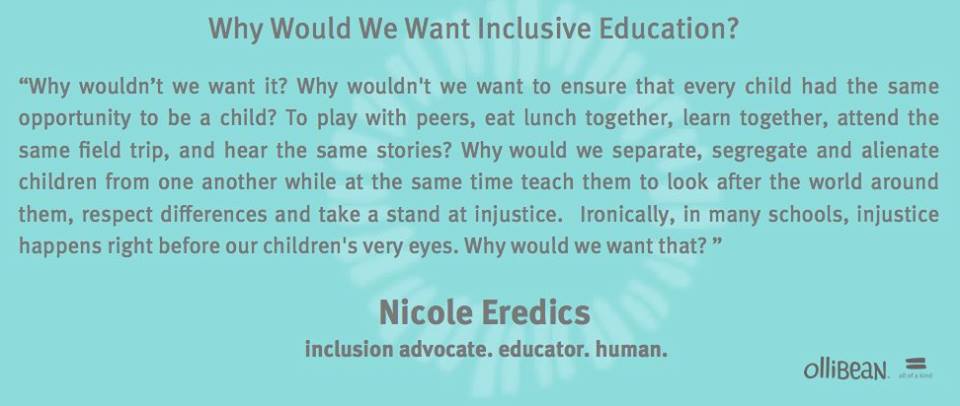
inclusive.png
Amy Dietrich Hernandez

*** UPDATE*** via my Facebook status

Success! They saw how passionate we were about keeping Charles a (home school mascot) and he will be one! We've worked out a collaborative program with (other school) where he will start his day there, get a few of the harder subjects in the morning, then spend the afternoon at (home high school) every day. We will push for full time as the years go on, but for now, this is the best of both worlds: more support in areas where he needs it and VISIBILITY at his home school. Whooo!


Friday, February 14, 2014

Okay, Denmark...You've Got My Attention

I once spent the day in Denmark.  Well, I guess it was two days, one day coming and one day going.  I was trying to get from Helsinki to Lausanne, Switzerland and I had to take a bunch of boats and trains.  It was a long time ago, so excuse the sketchy details.  The only thing that I really remember is being pretty well broke by the time I got to Switzerland.  I ate a lot of leftover bread on that trip.  Ah, youth!

Anyway, Denmark has been on my mind, lately.  Even before the news of the unfortunate giraffe, Marius, reached me, I had been thinking about what kind of society they had there.  Sure, it is a happy society (see this survey) and maybe that is part of what scares me about it.  As soon as I heard about Marius I (for now it appears there is a Marius II; note to self:  Don't be a giraffe named Marius in Denmark), my mind went to thoughts of the Down syndrome population in that country.  In Denmark, like most Western countries, Down syndrome births are dwindling (check this out).

I don't want to get into the whole subject with much depth here, mostly because I don't want this post to go on for days.  Suffice it to say that I have a problem with people thinking that this is a great thing.  It really bothers me that some people think it's a great thing; mostly, because I have a son and friends and other people I care about that have Down syndrome and I think a world without them would be decidedly more...sad.

So, I just kind of wonder what kind of great society promotes the killing off of those who are seen as unneeded or unwanted or less-than?  

What does it say, when a zoo helps to create, names, raises and then decides to kill a young giraffe...oh, and cut it up in front of cameras for the kids to watch.  Good times!  But, seriously, what does this say about what life means to these people?  Life is good only if it directly benefits (read:  makes money for) others?  Life is only good if you are born the right height/weight/sex/color/creed/national origin/sexual orientation/with the right number of chromosomes?  

What did this giraffe do to deserve to be fed to the lions he shared the zoo with?  

I've read some of the comments about the subject and many say things along the lines of "giraffes are lions natural prey, anyway" and "you would just have to kill a cow instead, so what is the difference?".  I can kind of see where they are coming from.  After all, a cow's life is as important to that cow as Marius' life is/was to him; but there is something about breeding this animal, wanting him until he was deemed unnecessary, then killing him that is deeply disturbing.  And it reminds me of the free, prenatal screening for T-21 that Denmark offers.  And it feels icky.  And I get that a giraffe is not a person.  It still feels icky.

If you don't love a person with Down syndrome, maybe you don't understand what I am saying.  Maybe you think I am crazy.  Maybe YOU think it's a great thing to eliminate Down syndrome and with it, part of what makes my kid MY KID.  I would ask you to keep an open mind, though and hear me out to the end.  

Do you know someone with Autism (prenatal test)?  Do you know someone who is gay?  Because guess what?  With all the genome testing that is going on, prenatal tests are coming for those conditions as well, all in the name of "advancing human health".  What does it mean for us as human beings to choose to eliminate traits that are a natural part of the human condition; not diseases, not conditions incompatible with life, but traits that could be seen as less than desirable?

And even if diseases like cancer and heart disease and schizophrenia could be diagnosed before birth, what would we do about it?  Since just about everyone will get one or the other at some point in their lives, COULD we do anything about it?  What if you found out at age twenty that sometime before you turned fifty you would have a massive heart attack?  It's quite likely, actually; much more likely than being born with Trisomy 21.  Would you want to be shot in the head to spare you the misery?  Or would you want to fight for your life?  

Human beings are beautiful because of their differences from one another.  One race, hair color, orientation or neurology is not necessarily better than another.  Should we, who have apparently "won" the neurological lottery, have control over the fate of those who haven't?  And if so, are we conducting our own, decidedly less messy, though no less troubling, form of Aktion T-4?  

I worry about where we are headed.  I worry that we don't learn our history lessons.  I worry that in our quest to become "better", we will wind up bereft. 


Thursday, January 9, 2014

Shame On Us

Today is Robert Ethan Saylor's 27th birthday.  

If you don't know Ethan, I have written about him here, herehere and also here.

I will sum up Ethan's story in a few words:  He was born in 1987.  He had Down syndrome.  He loved and was loved.  He died on January 12, 2013, three days after his 26th birthday, over the price of a movie ticket.

My last line usually garners much debate in articles, but essentially, that is what happened.  The exact details of the incident that happened in the few minutes between screenings of "Zero Dark Thirty" may never come out, because maddeningly, shockingly, sadly the off duty officers involved in Ethan's death were never charged with anything.  Ethan's death was ruled a homicide, but no charges were ever filed (you can read more about that, here).

I find it hard to understand.  If someone can be charged with involuntary manslaughter when they accidentally kill someone with their car, shouldn't they be charged with the same if the accidentally kill someone with their hands?  I am no legal scholar, but something seems amiss, here.

Since that day, it has been mainly on the family to speak out.  They were joined by some Down syndrome advocates in crying out for justice.  We have called upon our national organizations to act, to denounce and to support and eventually, with much prodding from the advocates, our national organizations began to speak out, though,  too quietly and nicely for my taste.  If it had been up to me, as director of a national organization WHOSE VERY REASON FOR EXISTING is to advocate for those with Down syndrome, I would have called for an ad in every national paper saying "Down syndrome is not a cause of death".  But, that's just me.

So, it was mostly up to the family and a small group of fierce advocates to get the story told.  Slowly, articles began to appear in national papers, but still there were plenty of people even in the Down syndrome community that hadn't heard about the story, even six months after it happened and even still, today one year later.  I find that absolutely appalling.  I find it hard to understand why you can say the name Trayvon Martin and everyone knows whom you are speaking of, but saying the name Ethan Saylor doesn't even necessarily ring a bell with people who should care the most.

Part of me understands that people don't want to be reminded of all the terrible things that happen in the world.  I can relate to that.  I don't watch the news with any regularity because of it; it all seems like bad news, from the top stories to the weather.  They may save 45 seconds at the end for some kind of "feel good" moment, as if that will erase the last half hour from our collective psyche.  It doesn't work.

So, many of us surround ourselves with what feels good and we try to ignore the bad and the ugly.  We look at cute baby pictures instead of dealing with what is frightening.  I do it, too.  There are times when calling for justice seems like a monumental task; mostly, because it is.  There are times when all I want is to hug my own kids and look at pictures of babies and kittens and to stick my fingers in my ears and say "la la la la, I can't hear you".  And I do; sometimes, for weeks.

I have to get back to the fight, though.  I can't tolerate just being sad or angry.  I have to act, or else I feel like I have no right to complain.  I deserve an injust world if I am not willing to fight for justice.  

I think this is a lesson that the Down syndrome community needs to learn from the LGBTQ community.  When one of theirs is hurt or killed, we all hear about it.  We all react.  Those of us who have the will, act, in ways big and small, so that justice can be carried out.  We work together to make the world better, not just for LGBTQ people, but eventually, for everyone.  

I have written before about this line of people waiting for justice.  Individuals with intellectual disabilities are on the back of the justice bus, it seems.  I wonder why we can't see that the line really doesn't exist and the bus is a figment of our imagination as well.  We are all human and we all want and need the same things.  A cry from one of us should be heard by all of us, regardless of race, sex, station, orientation, religion or lack thereof, etc.  If I can't see a bit of myself in every other living being, what hope do I have that someone will relate to me?

I urge the national Down syndrome groups to start acting for real change.  Do not let another year go by without calling loudly, publicly for change in the public perception of those with Down syndrome.  It's not about preaching to the choir.  It's about demanding that the rights for our children are recognized.  You have the means, you have the forum, all you need is the will.

I urge gay rights groups and women's rights groups and minority rights groups to look at Ethan and see your own fight and join us.

I urge individuals to stop crying over how sad this is and DO SOMETHING!  Pick up a phone, send an email, write a letter or a comment or a blog post or SOMETHING.  Take action, or expect to see more of the same again and again.

If Ethan's tragic death can mean a change in the way people with Down syndrome are treated, there may be some measure of peace his family could receive in that knowledge.  Isn't it the least we can do for them?  For Ethan?  For other victims of injustice?

If we don't care enough to act, shame on us.

Monday, November 18, 2013

My Reaction to the Article "The Preventable Death of Ethan Saylor" by Stephen Greenspan, Ph.D.

Here is the link so you can read it for yourself.

It has been shared many times since it came out last week.  I've seen it on national Down syndrome groups pages and on some friends', as well.  All I can wonder is:  why?  Are we so starved for press in the I/D community that we will cling to any scrap that blows our way?

Let me take a step back.  I am glad that the horrific, tragic, TOTALLY PREVENTABLE death of Ethan Saylor is getting more and more press.  I am glad it has not gone away.  I am glad that others have taken some of the pressure off his family for getting their story told; but this?  This is more victim blaming and there has been plenty of that, already.  It is a clinical summation made up of sketchy details and inferences.  

The reference to Ethan's IQ makes me want to climb through cyber space and throttle this guy.  Who cares what his IQ was?  For one thing, IQ tests for people with Down syndrome are not terribly accurate, especially when the tests were done years ago.  And even if 40 IS an accurate IQ, who cares? Seriously?  Is there in IQ threshold for watching movies?  If so, what is it?  Is no other measure taken into consideration?  

"I would have thought such a movie beyond the comprehension level of someone with Ethan’s IQ level, but presumably he enjoyed the non-stop nature of the action."  says Dr. Greenspan.   

Again, seriously?  Dr. Greenspan, with his many, many years of research and writing about intellectual disability should know very well that typically, a person with Down syndrome's receptive intelligence is much, much stronger than their ability to demonstrate their knowledge.  So, just because Ethan would not necessarily be able to talk at great length about what it was he found so fascinating about the movie, he did enjoy it and he would have been able to discuss it on some level if events had not unfolded the way they had.  Truthfully, none of that matters.  It's none of the doctor's business why Ethan saw that particular movie.  

Dr. Greenspan also writes about Ethan's weight being a factor in his death. This is pure nonsense.  Anyone who has a crushed larynx will die from it without immediate medical attention; period.  You cannot breathe when your airway is blocked, whatever your weight.  

Dr.  Greenspan blames Ethan for lashing out at the police officers.  These officers WERE NOT IN UNIFORM!  If they had been, maybe things would have been different.  The officers were moonlighting as security guards.  How was Ethan to know that they were really cops?  He was trying to get more money, via his phone, for another ticket.  In Ethan's mind, he was complying with the request that he purchase another ticket.  Whether that was logical or not, is beside the point.  In the few minutes the officers and management could have waited, without harming Ethan, his mom would have arrived, he could have had a new ticket, or he could have left.  They refused to give him the opportunity to make the situation right.  I find that indefensible.  

Even without all of that, even if the officers were uniformed and Ethan was hitting and kicking (which I have not read that he was), what does it imply?  That feeling threatened (with good reason, apparently) is a crime punishable by death?  I know, I know, they didn't MEAN to kill him; but they did.

"Whatever the tolerance level that police departments have for using potentially deadly force (and apparently the tolerance level is fairly high in the Frederick County Sherrif’s department), one would like to think that are other departments and officers, including within the Frederick department, who would view the behavior of the three officers in this case as unprofessional. It was unprofessional because police officers, along with other professionals (such as therapists), are paid to accept a certain amount of abuse without responding in kind. They are also being paid to recognize when a subject is in an unstable state, and to practice responses intended to calm rather than inflame. Unfortunately, neither of those hallmarks of professionalism were demonstrated in this case."  (emphasis mine).

I definitely think he has a point there.

The last part of the article gets to the heart of the matter, but doesn't tell us HOW to change things.  We certainly need the how.

 If there is any lesson to be learned from this tragic case, it is that the first instinct of first responders, as well as direct care staff, when dealing with immature behavior exhibited by brain-impaired people like Ethan Saylor, is tolerance combined with gentle insistence involving negotiation, both done in a spirit of love and attempt to understand the individual and help him or her to regain self-control.

On the last point, the doctor and I agree, but until we, as a society, have a better level of tolerance towards different communication styles, appearances and abilities, things like this will continue to occur.  We blame IQ, or cognition, when really what is to blame is prejudice and intolerance for difference.  How do we change minds when it comes to those with intellectual differences?  When will this population be recognized as having equal rights under the law, when time and time again, we are shown that the rules are applied differently when you have a disability as seen here and here?    

I realize that some will see this post as trying to have it both ways.  Maybe I am, but I don't think so.  I don't think it is wrong to suggest that waiting a few extra seconds before you decide to "subdue" someone when you SEE they have an obvious disability is unfair to the "typical" population.  I think it is compassionate.  

I am sure that Dr. Greenspan means well.  I'm just not sure that his post has helped the cause of getting justice for Ethan.


Friday, November 8, 2013

Why the R-Word Sucks with guest blogger, Nidhip Mehta

This post is a culmination of spending years trying to convey my feelings.  You can read this year's r-word campaign posts here and here.  I have written at least 427 other posts on the subject over the last 14+ years, but I will spare you those.  This latest post came from hearing about Kat Von D and her lipstick line at Sephora.  Long story short, they collectively decided that naming a lipstick "Celebutard" was a hilarious idea.  

Celebutard - from the Urban Dictionary:  


A famous stupid person. Typically refers to the current crop of vapid celebrities.


Similar, but not exactly the same as Celebutante: 


A person of high society and wealth whose famous just for the fact of being rich and fabulous. A socialite who is "famous for being famous."


It seems that no one spotted the irony of a tattoo artist who is famous for having a reality show and for sleeping with Sandra Bullock's ex calling anyone out for being vapid, or famous for being famous.  But, whatever. You can read more about that here.  


Once the disability community got wind of it, it took about 24 hours of tweeting, sharing and public shaming to get Sephora to stop selling the offensively named shade.  It was a victory, but a hollow one.  I am glad that as a community we were able to mobilize and have our voices heard.  I am troubled by the fact that it's a battle we have to keep waging.  


Here's another great post from a friend, here.


In the midst of the fracas, a good friend of mine, Nidhip, decided to play Devil's advocate.  He posed a few, well thought out questions asking why the r-word is so offensive.  He got quite an eye/ear full from me on the subject. We had a little back and forth with no real resolution, just a lot of anger, hurt and frustration on my side.  Again, I was getting nowhere and with someone who liked me and actually cared about my feelings!  How was I ever going to get the point across to anyone else?  


I went to bed fuming and in the morning I realized that getting upset was getting me exactly nowhere.  To top it all off, I was going to quite possibly lose an old friend in the process.  I did a little soul searching and then I wrote a note to Nidhip that said:  


Hey. good morning! First of all, thanks for getting me so riled up last night, it made me really think about things. Second, sorry about telling you to get off your high horse. I have an equally tall one and don't like to have it pointed out to me. Anyway, I was thinking that this conversation is a good one. I want people to understand where I am coming from, but it is very hard if you are not in the same situation. It's frustrating, to say the least. From the outside, you might see it as a debate over a word (which, in the scheme of things, seems inconsequential) but for me and many others, it's a fight for inclusion, for dignity, for justice and for civil and human rights. The word merely is a reminder of how far we still need to go in these areas.
I'd really like to write some more about it. I know I won't convince everyone, or maybe even you, but I would like to try and engage in healthy debate. As you can tell, debate is not easy for me. Arguing is fine if I don't truly care about the answer, but when I do...oh boy. I am all emotion. I know logically that a word should not hold so much weight, but emotionally, it does, it really does.
I'd like to try and work through this some more. Would you be okay with me putting your questions in a blog post and answering them? Or would you want to write something different? Or go back and forth? I think it could be a really good thing. If you don't want to add anymore, I understand, but if you would allow me to use your questions, I'd be grateful. Think about it.
And being the good guy that he is, he said this:
Hey, first of all, I just want to say I'm sorry again. I know with hindsight, you're thanking me, but I really should've gauged the situation better before opening up something which clearly has an emotional resonance. You're right, I tried to intellectualize something which, at its heart, is emotional. But I honestly think that it helps to do that when you're trying to create awareness or change minds. Which is why I was getting at you for simply saying that it shouldn't happen because it makes people angry. As you know, progressive thinkers like us do a lot of things that make other people angry, but that shouldn't stop us from doing it. Like wanting that anybody can marry anybody else, regardless of what the Bible says. That sure makes a ton of people angry, but I'm gonna go on wanting it.
Anyway, like I said last night, my questions came from a point of inquiry, not argument. I genuinely wanted to hear your point of view and well... I got it, I guess.
Sure, I'd be okay with my questions in your blog... after all, that was my point in bringing it up... to initiate discussion. But I really don't want to get anyone upset, let alone you. You are a great person and I admire you a great deal, but I want to respect your limits and tolerance as well.
And thanks for reaching out to me this morning. I really felt bad about upsetting you and regretted bringing it up. I admire that you're willing to put that aside and engage me again. That says a lot about you.
So, here is Nidhip's query. I will break it into parts in order to address different pieces of the issue; but first, here it is in it's entirety:

Ok, so my question is essentially this:
I sympathize with the feeling of being offended by a word or phrase. Ever since I learned that the R-word is offensive to some (particularly to those who have family members that are intellectually disabled), I stopped using it. I don't even use it when those people are not around, and I try to remind others when they use it. Also, I understand the negative connotation when the word is used to describe someone with Downs Syndrome or autism spectrum. It's really not appropriate, and it's not such a big thing to simply use another word.
What I don't completely understand is when the word is used outside of that context; when the intent has been changed from the original meaning. This happens in language. It happened with the words "moron" or "idiot" or "stupid", which were all used at one point as clinical descriptions of people with intellectual disabilities. These days, no one bats an eye or hesitates to use these words. Heck, even people who have family or friends with intellectual disabilities use these words, which a century ago had the same meaning and connotation as the R-word.
Is it not possible to divorce the word from its meaning? Can the perception of those who use the word be more nuanced? Shouldn't there be a distinction between those who use the word offensively and those who do not mean offense?
I'm not exactly saying that people should simply ignore it when people use the R-word, but that perhaps they should react in accordance with the intent in which the word was used, and not simply react from pure emotion.
I also think that in order to make people better understand why they should not use the R-word, the reason given should be more than "it makes me angry" or "you'll never understand unless it happens to you". I think these don't help the cause, primarily because unless the person involved is a friend or relative, no one really cares whether something they say makes some anonymous person angry. I believe in many things that make people angry, like feeling that gays should be able to marry or that all people should have access to affordable (or free) health care. The fact that this makes some people angry does not bother me in the least; it's a fundamental disagreement. So, I guess that in order to better understand the issue, I'd prefer to see a more intellectual rationalization for not using the word, as opposed to an emotional one.
Of course, what I prefer doesn't always matter. There may not be, after all, an intellectual rationalization. Maybe it should suffice that enough people (whatever that critical mass is) find it offensive. But the intellectual part of me wants to know where to draw the line, because it seems very fuzzy and, to be honest, hypocritical. Especially when I see the words "moron" and "stupid" being used all the time. I don't know, perhaps it simply has to do with the amount time that passes for a word to fully change its meaning. It's difficult to parse, unfortunately.
Again, I want to reiterate that if the word offends people who I like and admire and want to stay friends with, that's good enough for me. But it may not be good enough for everyone.


My response: 

I think there are essentially three parts to this:


  1. Is it not possible to divorce the word from its meaning, in the way idiot and moron have lost their original clinical meanings?
  2. Shouldn't there be a distinction between those who use the word offensively and those who do not mean offense?
  3. Is there a way to intellectually rationalize why it is wrong?

Is it not possible to divorce the word from its meaning, in the way idiot and moron have lost their original clinical meanings?

First, some people are bothered by the words idiot and moron and imbecile because of their historical significance to people with intellectual disabilities. For myself, I feel that those words have evolved to a point that when someone says any one of them, a picture of a kid like mine does not pop into their heads. I haven't seen any offensive memes using a picture of a kid with Down syndrome and the word "idiot"; but I have seen plenty with the word "retard". That makes them different, as far as I'm concerned. Maybe it's the role of social media that makes this word different (for me) from the rest. It certainly plays a part.
Secondly, I don't wish to drag up every old word used in reference to people with i/d. I feel they have run their course, history has moved on and so should we. The difference with "retard" is that it IS in common use these days and because of that, it keeps anyone who could be called "retarded" by a doctor (even though it is going away in the medical field) apart from everyone else. It makes them the "other", not like us, not worth worrying about offending, maybe, not even quite human.
Thirdly, though I could wait for this word to become innocuous, I don't want to. I want to stand up now and say that it matters to me and it matters to my family and many, many families like mine.  Why should my kid, who has been called a retard more times than I can count, have to hear that word in any form (including added "tard" to the end of other words)?  

Shouldn't there be a distinction between those who use the word offensively and those who do not mean offense?
Why should the offender (even if it was not meant to offend) get away with impunity?  I see it as a matter of simple humanity.  Most people don't want to hurt people's feelings, even people they don't know.  I think educating those who truly don't realize that their words are hurtful is important.  It's not about getting angry (Nidhip:  you seem to only see my anger and not my hurt.  I'm wondering why?), though I do get angry about it.  When someone uses the word "retard" and I am in earshot, more often than not, I use it as a teachable moment.  I avoid calling people out in public unless they are being blatantly disrespectful, but I typically pull them aside later on and say something to the effect of "this is a hurtful word, I know you didn't mean it to be, but it is" and nine times out of ten, they are apologetic.  Some (many) still use the word, but at least I have planted the seed.  If they hear my voice in their heads the next time they say it, it might not feel as satisfying and hopefully, they will re-think it.

The reason I brought up being hurt versus being angry is that it is much easier (I think) to dismiss anger than it is to dismiss hurt.  People get angry for all sorts of reasons (as Nidhip brought up) that I don't agree with.  Frankly, I think much of their anger is misplaced.  But hurt?  I don't want to hurt people or be hurt.  Knowing that the r-word can be hurtful should be enough.

While there is a difference between being deliberately hurtful (Hey, Retard!) and being unintentionally hurtful (That's so retarded!), the word still hurts.  It is associated with being bad, stupid, ugly and foolish AND it may be a part of a doctor's report; therefore making it a part of a person with a diagnosis.  Would you want any part of what makes you YOU be a slur? 

Is there a way to intellectually rationalize why it is wrong?

I've said that to disability advocates, this is the N-word. Do we use the N-word in any form?  No.  Because most reasonable people get that any form of it is degrading and wrong.  They wouldn't dream of saying "oh my god, you are such a nigger" to a friend who's acting silly.  But, "you're such a retard"  is fine.  Why?  What is the difference?  

The only difference I see is that blacks have had (and in many cases, still need) their civil rights movement, while the civil rights movement for the disabled is still in it's infancy.  You would be horrified if a school refused to accept a child because they were black today; but every day, schools refuse to accept children who learn differently, many without even giving them the chance to show that they can adapt in a mainstream classroom.

This happens today.  

Yes, kids with i/d learn differently than other kids.  And typical kids learn differently from each other.  With creativity, love and support, everyone wins and everyone learns more.  There is no excuse to leave some kids behind for any reason, whether it is sex (in some parts of the world, girls are still under-educated), race (hello?  American south in the 1960's?), or ability (today, all over the world).

My intellectual rationalization would be that the r-word keeps people with intellectual disabilities separate from the rest of society the same way the n-word kept black people separated from society.  Both words say "you are different, you are not worthy, you are not accepted".  If you look at the history of the civil rights movement, you will see that many of the things that were done to black people are still being done to those with developmental disabilities.  The only real difference is that not many have yet noticed that the disabled, as a group, are calling for their rights as human beings to be recognized.  Like African American, women and gay people before them, people with disabilities are calling for equal treatment.  Eliminating slurs against them must be a part of that movement.

Sunday, June 30, 2013

Reality vs Possibility

About a month ago, I had a disappointing but eye opening conversation. 

(I'm going to apologize for being somewhat vague in this post, but hopefully, you'll realize why)

You know those surveys that you are sometimes asked to take?  You know, the ones that are supposed to help businesses improve?  I'm sure you do.

The place I had been working asked us to do the same thing periodically.  I never found them in depth enough to really convey what I thought.  So, I eventually brought my ideas for improvement to a supervisor.

I sent an email and never heard back.  Then I sent another and had the same experience.  After the third email and several weeks went by, I forwarded them to her supervisor.  I wasn't trying to start trouble, really.  I felt I gave the first person more than ample time to respond and when she didn't, I moved on; plain and simple.

I feel very strongly that what I do is important.  I love working with the intellectually disabled population and since I have three boys of differing abilities, I see it as absolutely imperative that progress be made in this arena.

I didn't feel that my ideas were particularly radical.  What I was asking for was basically a pathway to full inclusion in recreation.  After all, it is what most people want for their children and it has to be the way of the future.  Segregation, even within a great model, is still segregation.  

I was taken aback, to say the least, when this person I was counting on to help me take us in this direction berated me for a full thirty minutes on the phone.  How dare I question the way things were done?  How dare I dispute their greatness?  Did I not know that we were the model for "How Things Were Done?"

I may have, at this point said that if we were the model, then that was pretty sad.  I might have.  Ok, I did say that, verbatim.  Yes, I was talking to someone who could have fired me on the spot.  I may have even hung up the phone and had her call me back.  Ok, that happened too; I'm not proud of it.  But, let's face it; I was pissed.  

How dare she tell me that there was no room for improvement?  How dare she say that there are some people who want segregation?  For real?  Like, really?  Forever and ever amen?  What?!?!?

How do we get the general population to see our citizens with intellectual disabilities as anything more than a burden, a waste of resources (read:  money) as HUMAN BEINGS if they are continually separated from the rest of us?  

And it's taken me a full month to realize that if this is the best that this group can do; then it is time to move on.  I am not ready to settle for the "best".  The best the disabled have right now SUCKS.

I am ready for a new direction, with like minded individuals.  I am ready to break a new trail towards full acceptance and inclusion for my children and for all the children that come after them.

I am exasperated by those who have been on the back of the bus for so long, that they forget they are even on a bus.  Don't you want more, goddamnit?  I know I do.

Wednesday, May 29, 2013

Guest Blog on Behalf of Stacey Calcano and T21 Brigade

I am honored to be a part of a tiny, but mighty group of determined advocates for people with Down syndrome.  ~ Amy

Wednesday, May 29, 2013


Open Letter to the National Down Syndrome Society (NDSS)

NDSS began the Buddy Walk in 1995 to spread its mission of promoting the "value, acceptance and inclusion of people with Down syndrome at the local level." In 2012, nearly 300,000 people participated in a Buddy Walk across the United States, and over $11 million was raised in the process. Local affiliates are expected (and contractually obliged) to give a certain percentage of earnings to the NDSS, as payment for utilizing the Buddy Walk name (trademarked) and framework.  Ethan Saylor, a young man with Down syndrome, died at the hands of sheriff's deputies in Maryland after refusing to leave a movie theater in January of this year, and NDSS ("The National Advocate for People with Down Syndrome Since 1979") has been criticized for its lackluster response in the aftermath of his homicide.  NDSS would like to separate the "joys of the Buddy Walk" from the "Ethan Saylor tragedy," while advocates for Down syndrome all over the world are left questioning the commitment of the NDSS to its mission. The Buddy Walk is the largest fundraiser for the NDSS. 


May 29, 2013

An Open Letter to the National Down Syndrome Society
(Why My Family Won't be Participating in This Year's Buddy Walk)


Last year, my family raised nearly $10,000 for our local Down syndrome group's Buddy Walk (our fundraising effort was so large that I was recently contacted to help field test this year’s newly improved Buddy Walk website).  Unfortunately, I cannot in good conscience participate in this year's Buddy Walk efforts after your failure to meaningfully advocate for justice in the aftermath of Ethan Saylor's homicide.

Two years ago when our family received news we would have a child with Down syndrome, I turned to you, the National Down Syndrome Society, for guidance and assurance.

Your mission statement served as a beacon of hope in a time full of unknowns:

The mission of the National Down Syndrome Society is to be the national advocate for the value, acceptance and inclusion of people with Down syndrome.

We were inspired by this message—and by our young son with Down syndrome—and became very involved in our local Down syndrome community.  We began revving up the troops for our first ever Buddy Walk. The 2012 Buddy Walk was our first experience as part of a much larger community.  We raised so much money that I received a gold star in recognition of my fundraising efforts. I thought, “A gold star!  I got a gold star for Carter!” The day was magical, and everything I'd hoped it would be.

The faith I had in your organization quickly faded in the wake of your late and limited response to Ethan Saylor’s homicide, a true test of your commitment to your advocacy on behalf of those with Down syndrome.  When I learned of Ethan's death, I wanted desperately to contribute in any small way I could to help his family find justice.  I knew that would not happen without an independent investigation into his death, and assumed the NDSS would take a leadership role to ensure this case got the attention and outcome the Saylor’s deserve.  Sadly, the NDSS response was not only deplorably late, but efforts to secure an independent investigation for the Saylor family were absent or minimal. 

The first statement released by F.R.I.E.N.D.S (and supported by NDSS) did not come until six weeks after Ethan's death, and emphasized that F.R.I.E.N.D.S are “strong supporters of the Frederick County Sheriff’s Office.”  Subsequent statements by NDSS stated that the organization was “determined to see to it that necessary and comprehensive actions are implemented to ensure tragedies like this never happen again,” but this determination came at the cost of any effort to secure an independent investigation.  In addition, later press releases had erroneous information, called for no action from the Ds community (asking the community to please not attempt to contact the Department of Justice) and failed to adhere to a language of inclusion and respect I would expect from such a large, respected advocacy group.

Recently, it has come to light that Ethan suffered unexplained injuries before his death (a crushed larynx, suggesting the use of force), yet there have been no new or renewed calls for justice and an independent investigation.

I enjoy reading the “My Great Story” pieces on the NDSS website, but not all stories about individuals with Down syndrome are “feel good stories" or have happy endings. Does that make them less deserving of coverage from our national organizations and national news organizations? I would argue these stories are more important, and where our collective attention should be focused.  We should all focus on righting the wrongs that befall people with intellectual disabilities every single day. Certainly the homicide of a young man with Down syndrome, who went to the movies and died while crying out for his mother, deserves our attention.

Last week, I received an email from the NDSS asking my help in beta-testing the newly improved Buddy Walk site for this year. In response, I wrote:
“Thank you for including me on this distribution. However, I am very conflicted about participating in this year's walk. I am very disappointed in the way the NDSS and the NDSC has handled the Ethan Saylor tragedy. There has been no community mobilization around the death of this young man. The silence of our national organizations is so disappointing to me that I honestly haven't decided if we can, in good conscience, participate this year.”
I received the following in return: 
“I totally understand where you are coming from and would never try to convince you to do something if it doesn’t feel right. You know I would love to see your family’s gorgeous faces, but only if they are smiling and feeling in solidarity with what we represent as a national advocate. I would very much like to separate the joys of the Buddy Walk program and the Ethan Saylor tragedy.I am sorry you feel this way about NDSS. I am really proud of the efforts of my colleagues that have been at the center of all of the conversations and have worked really hard to keep all of our communications about the topic balanced and professional.  Please take as much time as you need to think about it. Registration will remain open until event day.”
This felt like a clear message that we are not welcome at the Buddy Walk unless we are “smiling and feeling in solidarity” with what the NDSS represents as a national advocate.  I’m clearly disappointed in the lack of leadership from our self-described “national advocate for people with Down syndrome” and am not able to separate the “joys of the Buddy Walk program” from the Ethan Saylor homicide.  Having slept on it, I believe I’ve had all the time I need.

This year, my family will not be walking in the NYC Buddy Walk. I cannot, in good conscience, support the NDSS as the same organization I thought it was a year ago. I hope to rejoin the Buddy Walk next year, and I hope that something changes between now and then. I hope you start living your mission:

“The mission of the National Down Syndrome Society is to be the national advocate for the value, acceptance and inclusion of people with Down syndrome.”

In sadness,


Stacey Calcano

*For more details on Stacey's personal experience--as well as for specific links and a timeframe for the NDSS response on the Ethan Saylor case, please read "My Not-So-Great Story" here.